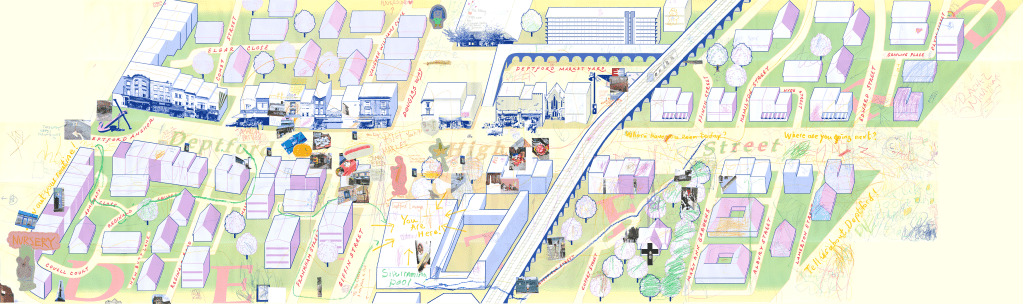
5 × 1.5 m community map with drawing, writing, and collage contributions from library users and workshop participants
You Are Here, part of Rhizomizing en Route, is an ongoing collaborative mapping project by Stephanie Chung, Sim Orme, and Studio Biped exploring navigation, belonging, and displacement. Through a participatory map installation and walking workshop at Deptford Lounge library in 2024, we brought together long-time residents and newcomers to examine how localities anchor community amid constant change.
Rather than treating migration as simply leaving and arriving, the project embraces the messy in-betweens of contemporary mobility. Participants mapped their daily routes and shared stories of finding familiarity in unfamiliar places. We developed a zine as both observation record and reflection, while preserving the installation as an archive piece. The work continues at Deptford X Fringe 2025 with a zine-led walk around Deptford.
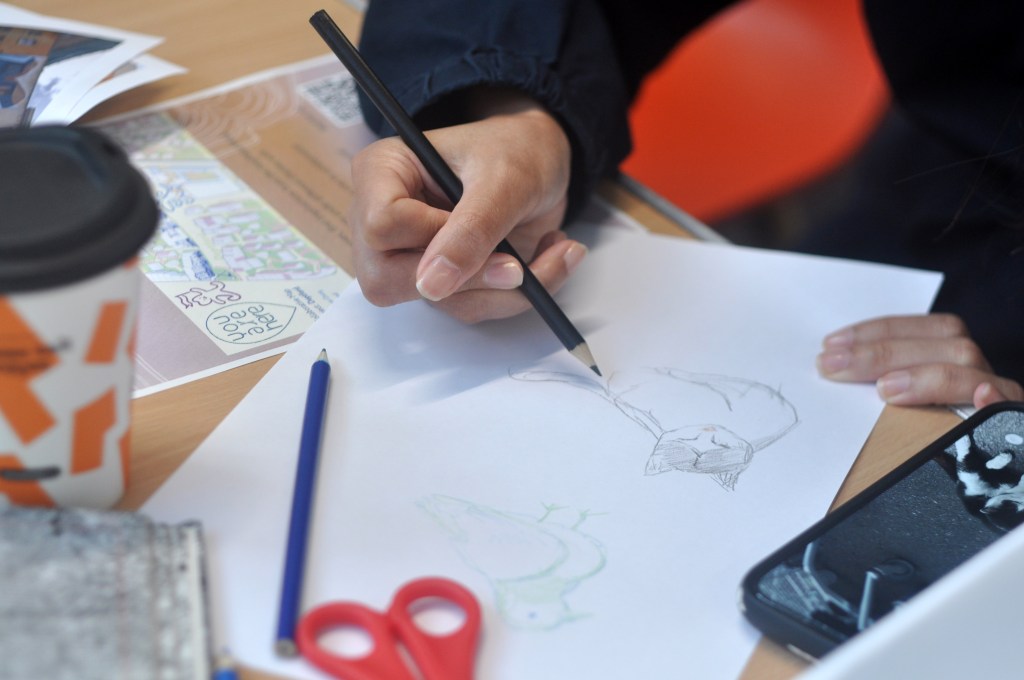
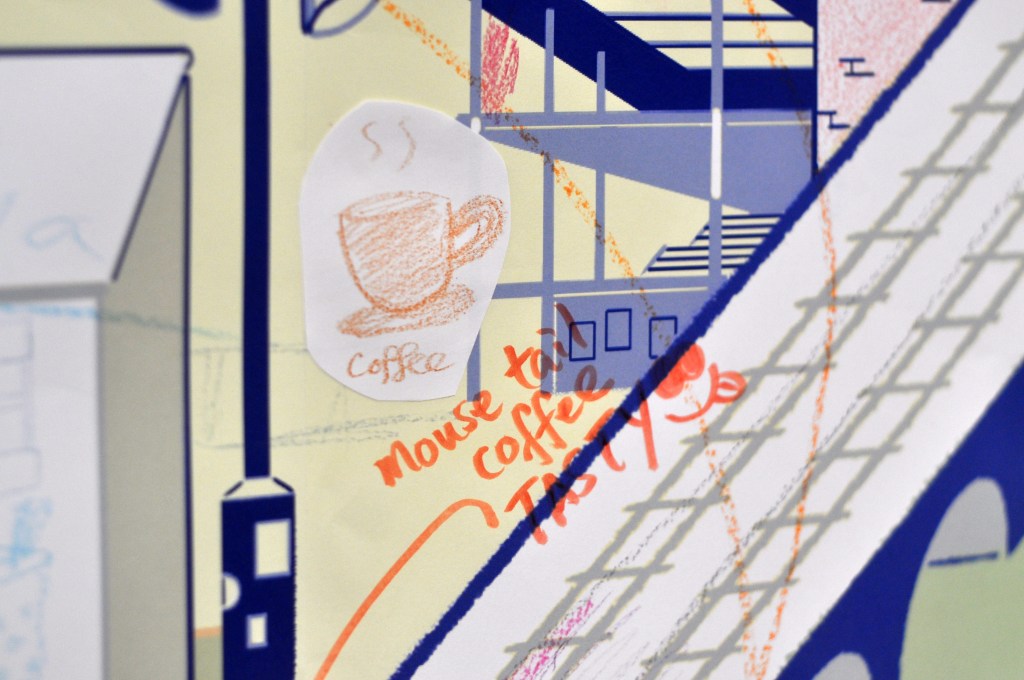
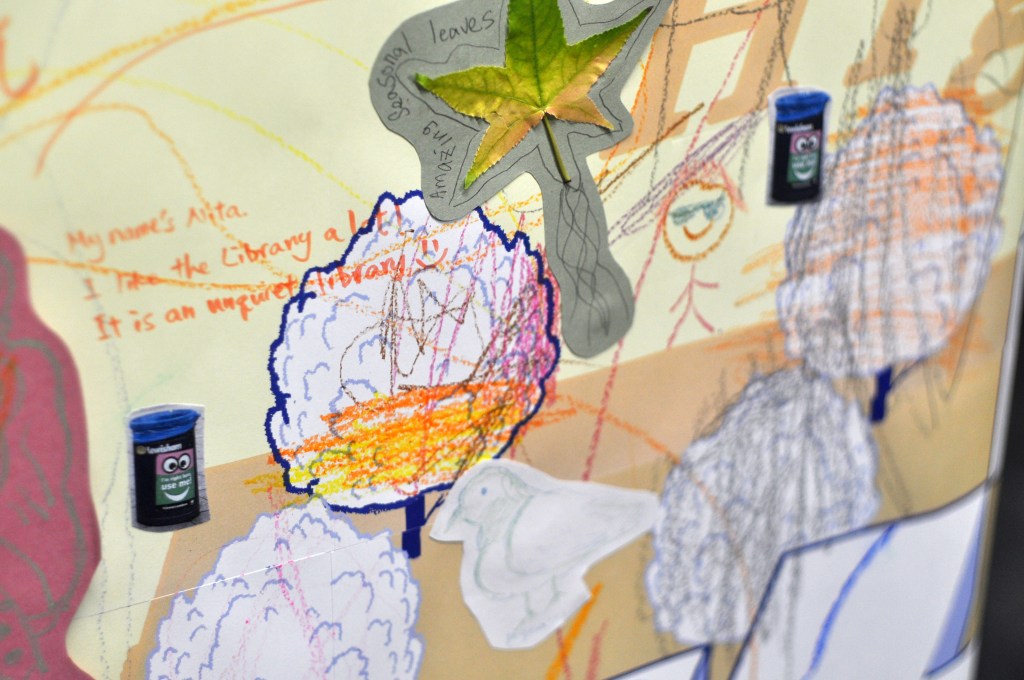
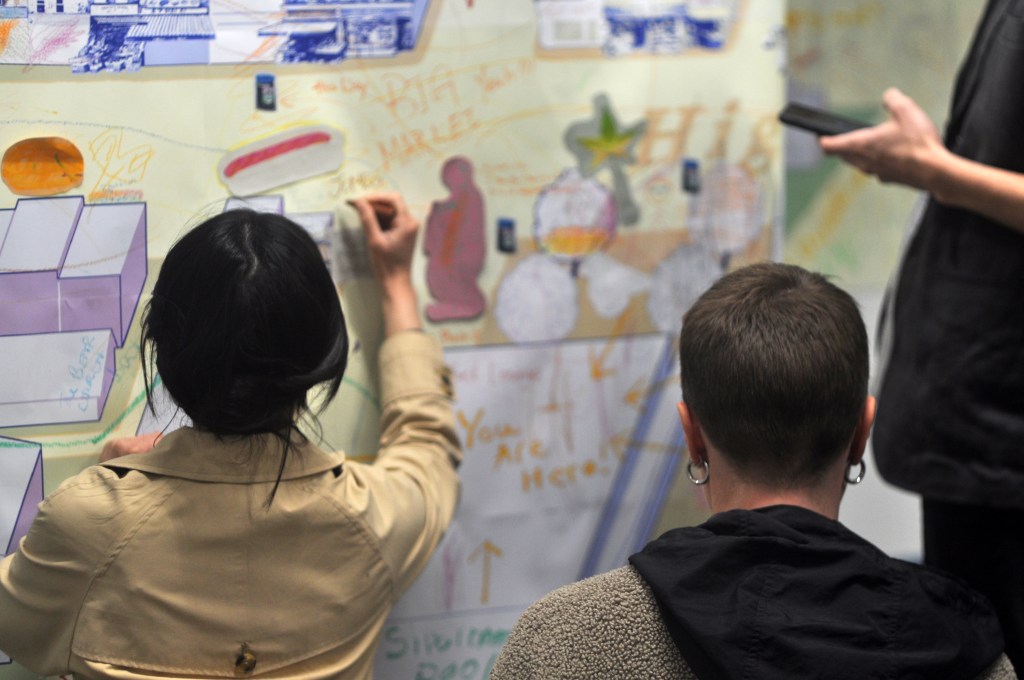
The mapping workshop which took place right after the walk
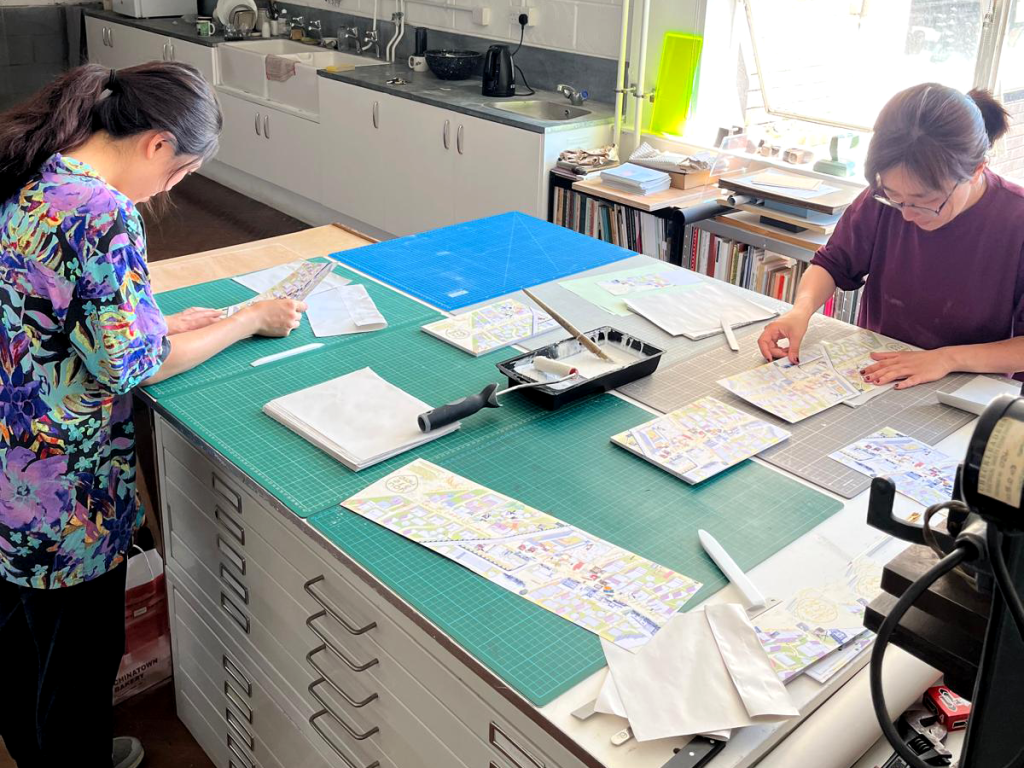
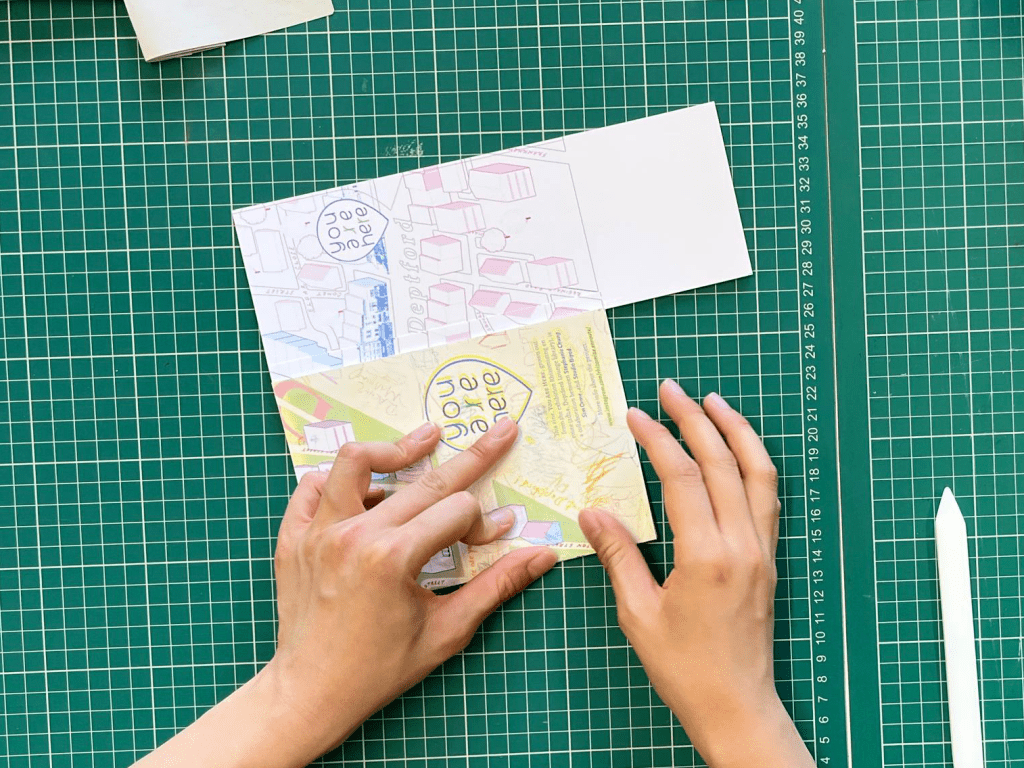
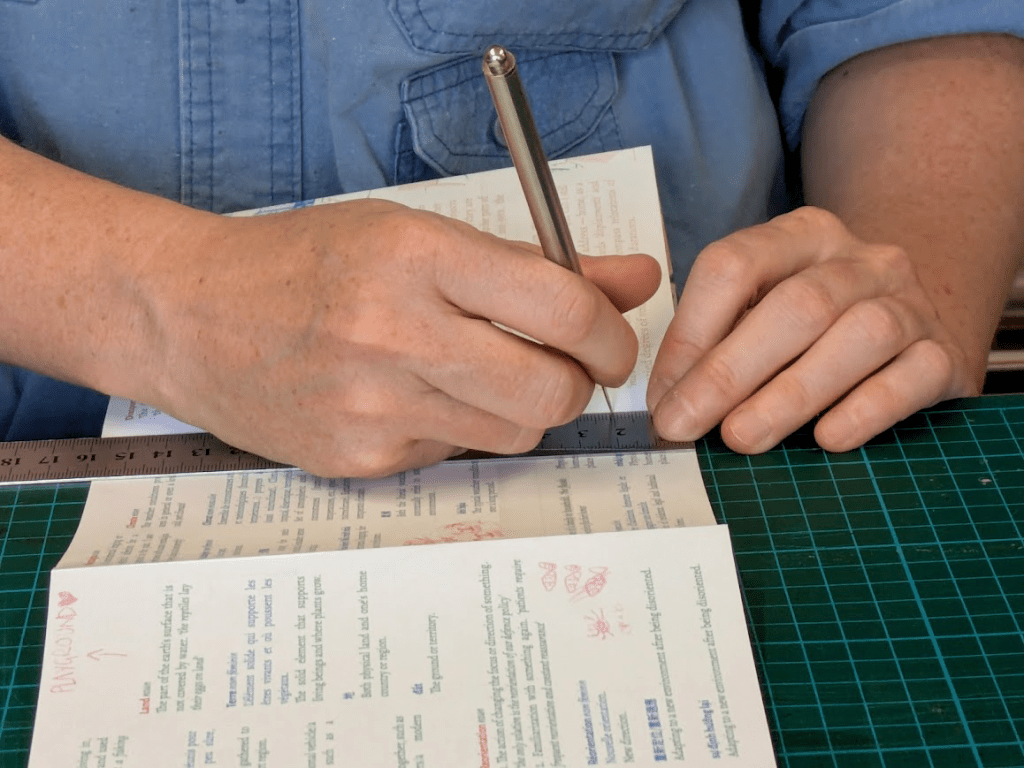
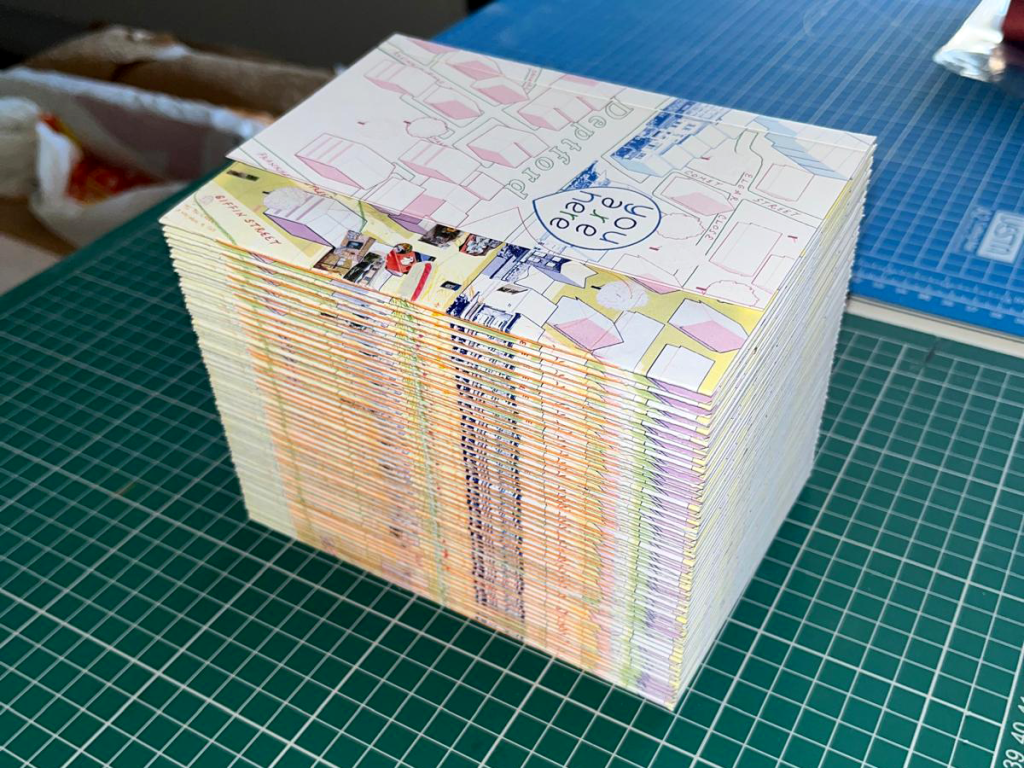
Making of the collaborative zine which is both a map and a zine.
The following is what I wrote for the zine on behalf of Studio Biped:
1
Where do we belong? “Home” might be the place, but a migrant is away from home. Though home could, in some cases, follow a person wherever they go, like a caravan. Some say home is not a place but an idea, so let’s think beyond a geographical where, by asking also what, who, when, how, and why. And perhaps more fundamentally, what does it mean to belong?
Google Maps, as an everyday tool, is pretty apt and to the point, if not a bit boring. However, we could still find ourselves utterly lost in it sometimes, for we rarely see streets from above like a bird. Intuitively, we remember a place as countless overlapping first-person journeys. The more we visit a spot, the higher resolution it is in our mind. On the contrary, that corner or back alley which never caught our attention remains blank, no matter how many times we’ve passed by it. So our sense of a place, it seems, is made up of two different components – one map and a blur of many journeys. Structure vs memories. Physical vs psychological.
To make sense of a place, especially as a migrant, we look for similarities and differences. The traders’ market in Deptford, for example, looks strikingly similar to that of Mong Kok, even if they sell rather different goods. Our other senses play a role too. The distinct smell of coffee, bakeries, spices, and seafood. A dusty road, salty seaside, and airy park. Each unique language, symbol, and architectural style might mean worlds to those fluent in them.
To belong is perhaps to feel familiar with all these special characteristics of a place. They might even change how we see ourselves, as one might proudly say, “I’m a Deptfordian!” or “我係土瓜灣人 (I’m a To-Kwa-Wanian)!” – if they wish. Yet, can we be absolutely sure a local isn’t a bit of a migrant too? A place, as well as our knowledge and feelings of it, are constantly changing. “No man ever steps into the same river twice. For it’s not the same river and he’s not the same man.” – Heraclitus, a Greek philosopher, once said.
These were some of the things we discussed in the first part of our walking workshop (6 July 2024) at Deptford Lounge, for the exhibition “Rhizomizing en route”. The second part, the fun part – the walk, is really where all of us, locals and migrants alike, walked through Deptford together and exchanged old eyes for fresh eyes – seeing the familiar anew and the unfamiliar through knowing perspectives.. There we discovered a third component which contributes to our sense of place.
2
Before starting our walk, we invited participants to look UP more, and look out for nature. Anything interesting overhead literally goes over our head, as we usually only look straight forward or down at our phones as we walk. The same goes for the presence of nature. Trees and sounds of birds: we don’t usually notice them until they’re gone. They’ve blended quite perfectly into the background of our daily lives.
After we left the library, we headed south along the high street, passing through a series of traders’ stalls. We then turned east upon reaching the iconic Deptford Anchor, and did a full circle until we were back at the library again. It’s a short route that nevertheless took us forever to finish, as we stopped by every remotely interesting sight, pondering and investigating, like kids.
About half of us that day were locals, either working or living here in Deptford. Naturally they had more insights to share, but they too discovered new things here and there. It seems we’re all accustomed to a limited number of specific routes in our daily lives. Always transiting between point A and B, and maybe C, but seldom wandering aimlessly… so a workshop like this might just be the perfect excuse!
During the walk, we saw a church in the middle of a nice park – at least now we know it’s a church. We weren’t sure in the beginning, we had questions. First of all, it looked Greek, with all its columns and triangular pediments. It was rigid and geometric, lacking frivolous decorations typically associated with a church. A school, a court, or a clock tower maybe, we guessed. As we got close, we started reading what’s carved above the front door. Okay, it did say “THIS Church was…” Finally, someone peeped into the keyhole, and exclaimed, Wow.
Bathed under sunlight streaming in through tall windows, a soft and tranquil interior of a church came into view. The atmosphere was incredibly warm, standing in stark contrast to the church’s cold stony exterior. The keyhole was small, so we had to take turns peeping in. Yet the joy of discovering what’s bigger on the inside was easily felt and shared, regardless of one’s religious belief.
We came across many similar puzzles throughout the walk. Church or not church, obscure murals, hilarious signs. And we’d piece puzzles together with bits of knowledge each of us held. Personal experience, local histories, and urban myths. The real answer was probably just a Google search away. We rely on Google for all answers these days. But when it’s a real group of people exploring in real time and real places, knowledge comes in the form of shared and multicoloured memories. And it’s more fun to be silly together anyway. Maybe it’s the magic of workshops, maybe we’ve always had questions regarding our surroundings, only waiting for the right chance to pursue the answers.
3
The third component is probably obvious by now – it’s the people! A river is not just the water but all the fish in it too. We fish love passing news, knowledge, and gossip among one another. The way people use a place shapes the place itself. To belong is to play a role in this complex shaping process. What we acknowledge as the characteristics of a place are the combined effort of many people, many generations even. No wonder regeneration and gentrification affect some people so deeply.
On the other hand, to emigrate is to leave behind all efforts made back home, and to fear never being able to belong again. Disorientation and reorientation can be a tedious and confusing process. As we attach ourselves to a world in perpetual flux, we naturally desire sun-soaked familiarity. Familiar colours, textures, smells, and faces – all these things ultimately make up a large part of who we are.
For our project, we set up a large illustrated map of Deptford in the library alongside a basket of colourful crayons. “Really? I can draw anything?” a child asked timidly. Yes! Anything! People soon began marking their daily routes, highlighting favourite spots, while workshop participants added photos from our walk. What emerged was a wonderfully messy collaborative portrait of Deptford, unique to this moment and this particular gathering of people.
This mapping exercise reminded us of a talk we’d attended months earlier at this same venue about Deptford’s market vendors. The library had created an evocative digital archive – 3D scans of market stalls paired with interviews – preserving vendor stories like time capsules. The broken polygons and ghostly motion blurs weren’t cleaned up but kept intact, mirroring how memory itself works – fragmented, sometimes hazy, yet emotionally resonant.
Social scientist Anita Strasser then shared her years worth of photographs documenting Deptford’s changing landscape. Despite gentrification and rising rents, the community showed remarkable resilience. When beloved shops closed, locals formed farewell queues stretching down the street. Family businesses passed between generations against all odds. Neighbours stepped in to help each other through displacement. Throughout the talk, long-time residents in the audience couldn’t help but chime in, each adding their piece to the neighbourhood’s collective story.
The boundaries between researcher, librarian, and resident melted away as everyone recognised their shared role in preserving history. Long-time locals and recent arrivals alike contribute to and draw identity from this district. Places like the market and library stand as silent witnesses to passing time, gradually collecting layers of stories within their walls or stalls. Every person – whether vendor, customer, or resident – weaves their own thread into Deptford’s rich tapestry of collective memories.
After the walking tour and workshop, all four of us went to that Vietnamese restaurant several participants had offhandedly but coincidentally recommended throughout the day. And it was wonderpho.
 Angela Wong's Portfolio