From animation to final render of the octopus
This essay is adapted from Studio Biped’s 2022 presentation on the new techniques of Find Find at the HKUST Animators’ Roundtable Forum hosted by the Association for Chinese Animation Studies. Isabel Galwey, who invited us to join, also wrote an extensive article on digital ink animation after interviewing Expresii’s developer and us. Her broader research examines how digital technologies have transformed Hong Kong’s animation landscape.
1
Find Find is an ink painting animation – or, as we sometimes call it due to its colourful palette, a watercolour animation. The most authentic and direct way to make one would be to hand-paint it frame by frame. Loving Vincent (2017) is a great example: labour-intensive, but with exceptional craftsmanship. Fast-paced commercial productions, however, can’t always afford such a luxurious and irreversible workflow, so digital alternatives are used instead.
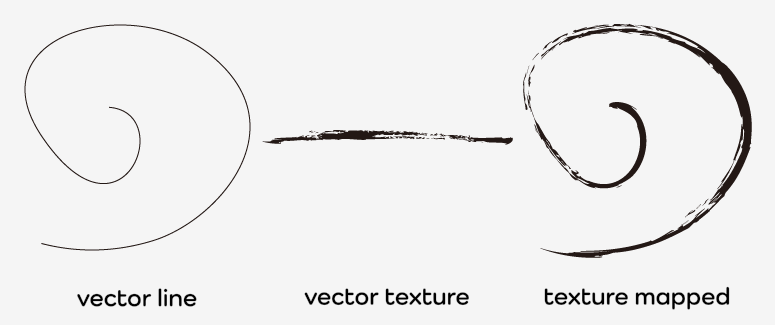
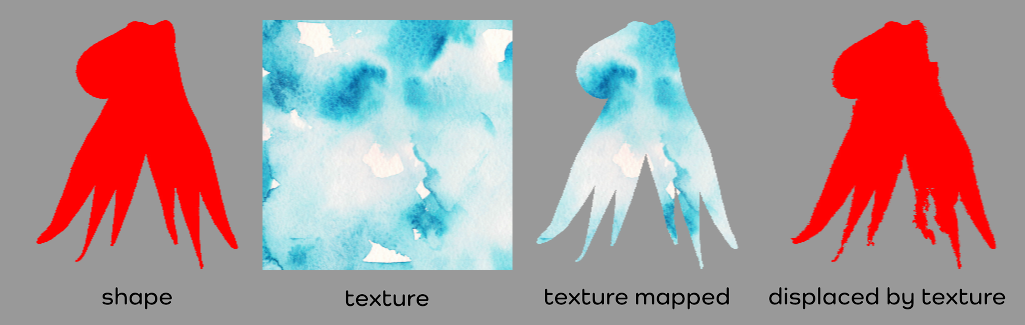
The standard digital approach involves mapping textures onto animations at various levels, from lines to planes to silhouettes. These textures can be transformed and distorted, making them somewhat adaptable to motion. This technique has become ubiquitous across advertising, independent animation, and feature films, such as the beautiful Ernest and Celestine (2012).
But Asian ink painting presents a unique challenge. Its distinctive style involves ink washes that blend together in ways that are difficult to prepare as textures, let alone animate. What’s more, in this tradition, lines and planes are interchangeable due to the ink brush’s versatility in mark-making. For Find Find, we developed a hybrid method that is neither pure texture mapping nor hand-painting, we programmed the computer to paint the animation frame by frame.
2
Demo of the computer painting a single frame
Our process relies on two key components. First, we worked with Expresii, a sophisticated software specifically designed for creating ink paintings. What makes Expresii remarkable is its 3D brush that mimics a real one, with ink behaviour based on fluid dynamics for realistic results.
Second, we used After Effects for vector animation and compositing. We converted the finished animated vectors into travel paths with computed pressure curves for Expresii’s brush to follow. Within After Effects, we also created a control panel to let artists adjust brush settings such as size, water content, and colour.
From vector animation through auto-painting to final compositing
This approach allowed us to tackle complex motions that would otherwise be very challenging if done entirely by hand, for example, animating all eight tentacles. On top of this, we developed a character rig with dual functionality: auto and manual modes.
The auto mode simplifies things by automating most tentacle movements, down to the unconscious curling of the tips. This mode is particularly valuable for swimming and drifting scenes. Conversely, the manual mode gives animators precise control over each tentacle individually, facilitating actions like grabbing and playing. For minor characters like the small crab in our film, we used automated rigs that handle all the walking while animators simply direct the crab’s movement.
Demo of an automated crab animation
While automation isn’t new – being widely used in 3D animation, VFX, and games – we built our own system using college-level mathematics. As Pixar’s motto suggests, “The art challenges the technology, and the technology inspires the art,” and this philosophy guided our research and development efforts to realise a unique vision for ink painting animation.
3
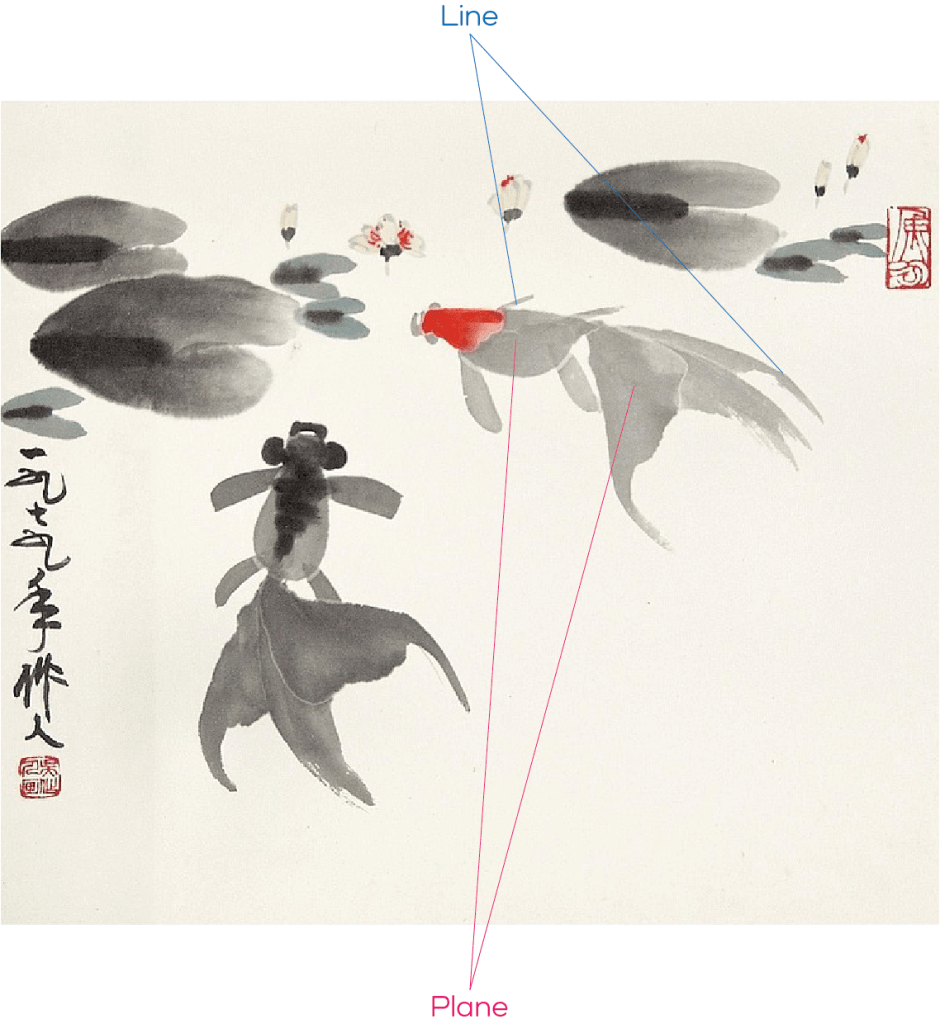
Painting of goldfish by Wu Zuoren
In Asian ink painting, line and plane are interchangeable, traditional techniques for painting goldfish tails demonstrate this perfectly. It is also this unique quality that inspired our octopus character design. The abstraction inherent in Asian ink painting creates its distinctive aesthetic, and we tried to capture this spirit throughout our animation.
Our environments, painted by hand in Expresii, use scroll-like compositions that appear as tracking shots in the film. Traditional scroll paintings often incorporate multiple perspectives within a single landscape, suggesting the journey witnessed by a bird in flight.
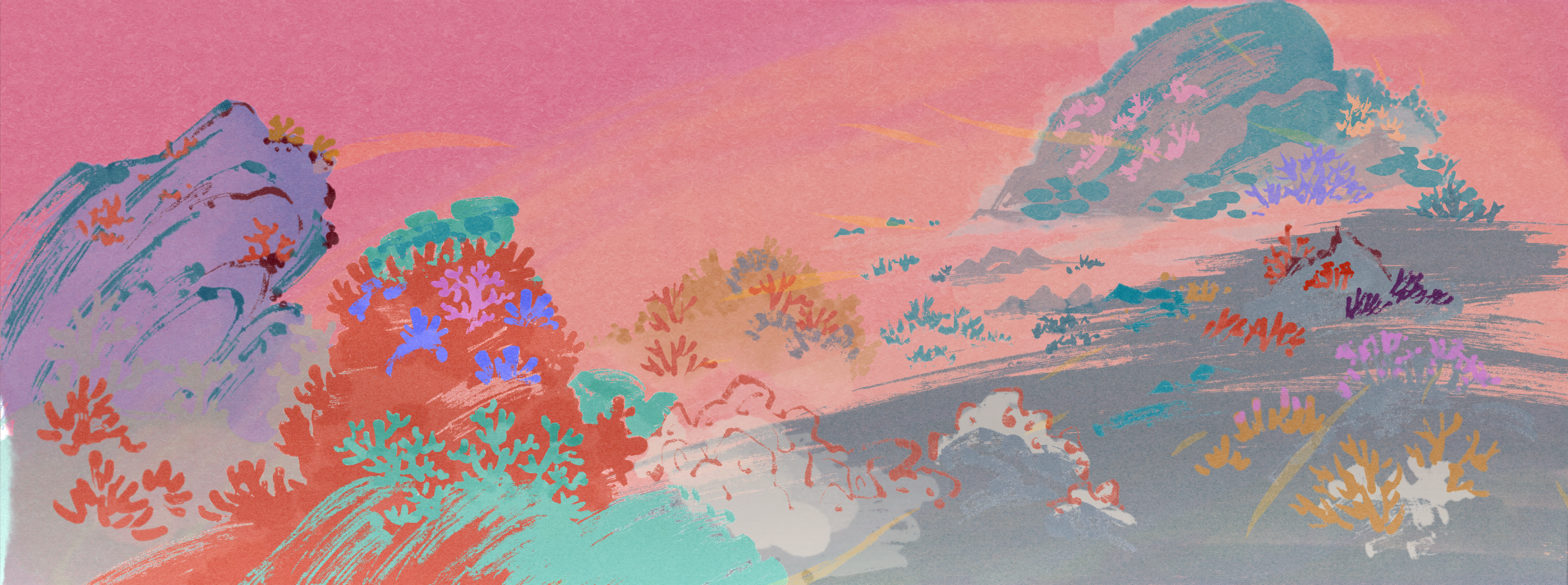
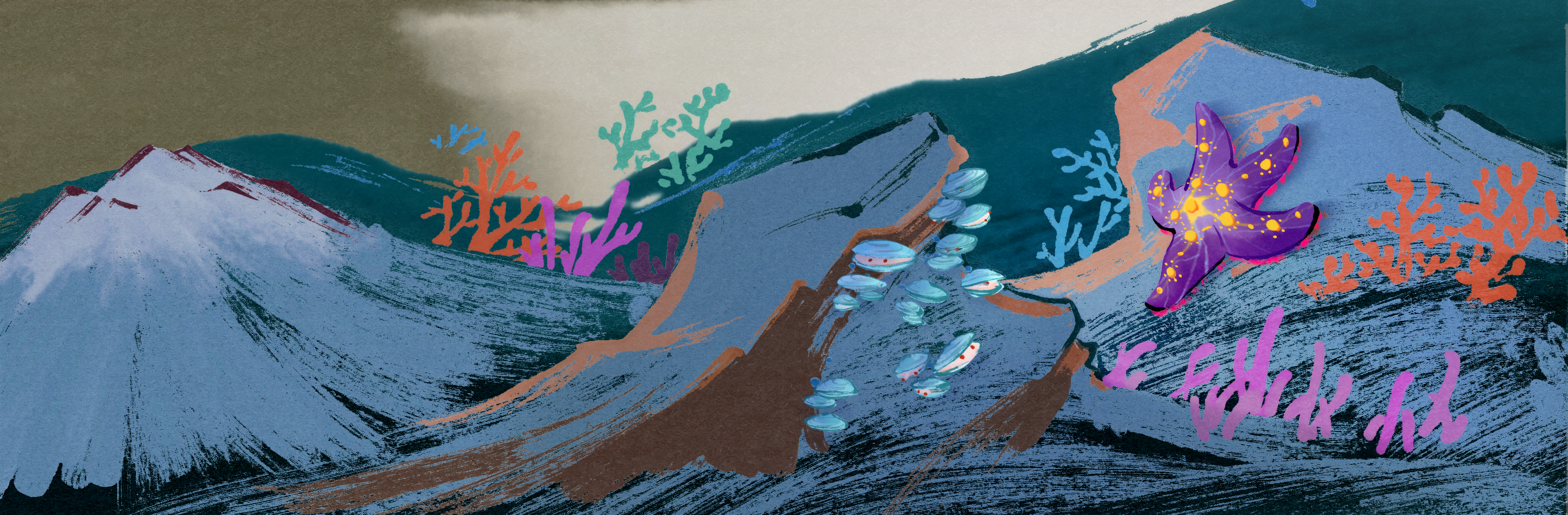
Scroll-like backgrounds painted by Leung Wing Shuen and Hillary Tang
In the underwater setting of Find Find, coral reefs become our mountains, and the sea’s surface the boundary of our sky. The octopus “flies” like a bird, and from her perspective, what lies above the water holds the same mystery as outer space does for humans.
The story follows a curious octopus whose life changes dramatically when a strange plastic cup enters her world.
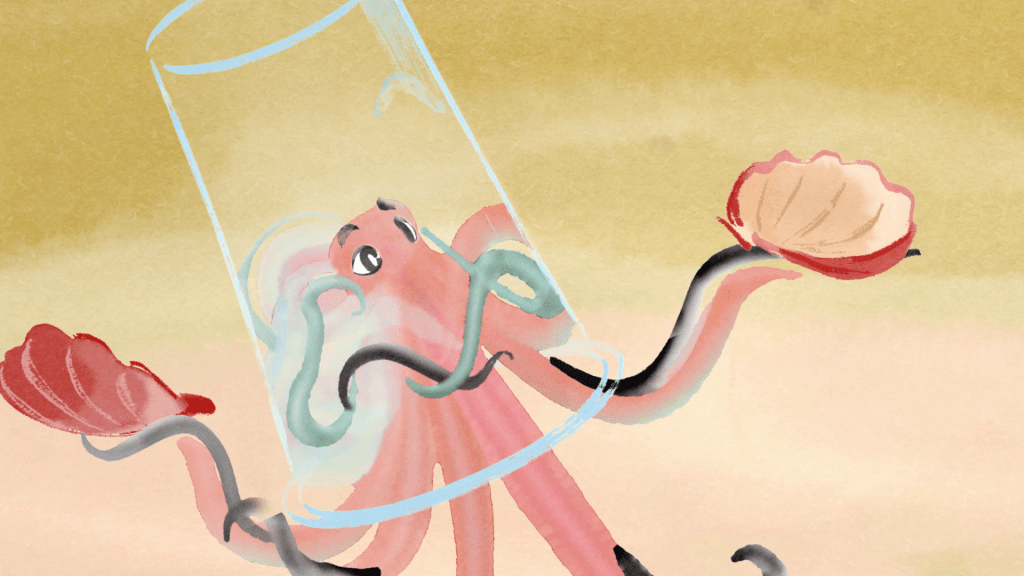
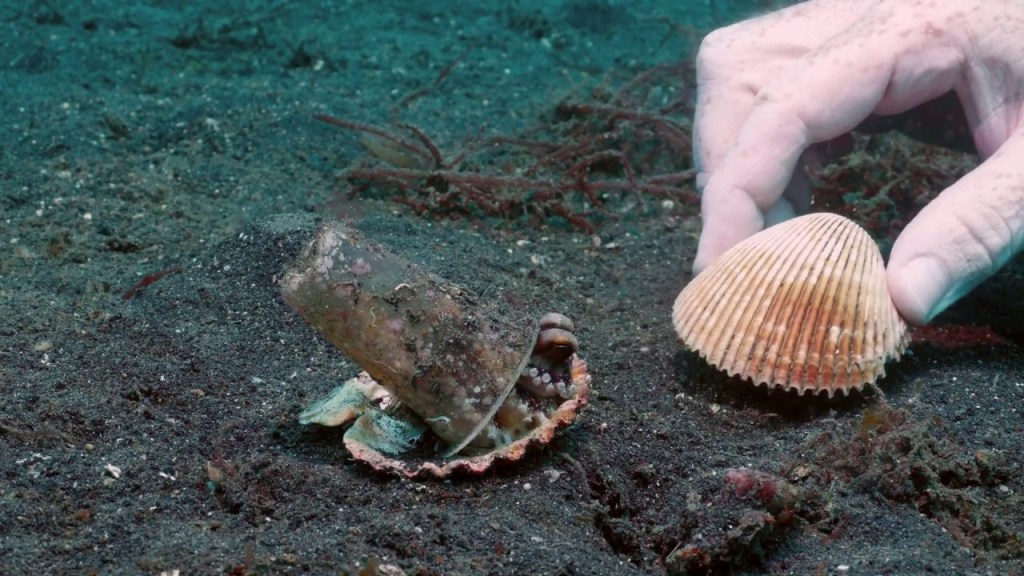
Our film’s protagonist vs the real octopus that inspired the story
4
While innovation can be exhilarating, it also introduces significant challenges to animation production. R&D creates “black holes” in an otherwise stable pipeline, because it is full of unknowns. To make it work, we had to allow sufficient time for R&D while simultaneously preparing fallback plans for when certain experiments proved unsuccessful. We faced practical issues like insufficient computational power and seemingly endless rendering times.
Another challenge was avoiding rabbit holes. At one point, I became fixated on implementing the Lindenmayer System (L-system) – a function for generating trees – for our coral elements, despite the fact that corals only appear in the background. Although I spent just two weeks on this detour, that was still precious production time wasted.
Through our struggles, we learned something valuable about animation R&D:
- Reciprocal relationship between art and technology: Initially, we believed technology should serve artistic vision, but we discovered that technology also inspires art. Our octopus design emerged from our desire to achieve an ink painting aesthetic combined with our technical capabilities.
- Maintain core goals: Despite shifting objectives based on technical discoveries, we remained committed to our primary goal of telling the story and completing the film.
- Respect the proven pipeline: Despite our new approaches to character rigging, we still began with hand-drawn animation. This preserved the artists’ vision and provided a reference point when the technical aspects became overwhelming.
- Question new methods: A novel approach isn’t necessarily the best or most efficient solution. Sometimes existing solutions or plugins will simply do, while in other cases, building custom tools better serves specific needs.
Creating custom tools for animation can be particularly rewarding. Years ago, I met Japanese animator Baku Hashimoto, who came to Hong Kong to receive an award at IFVA for his stop-motion animation featuring three dancing mochi. What captivated me wasn’t just its artistic merit, but how he specifically developed software to coordinate the camera movement and music in the film, a brilliant example of technical innovation in service of artistic vision.
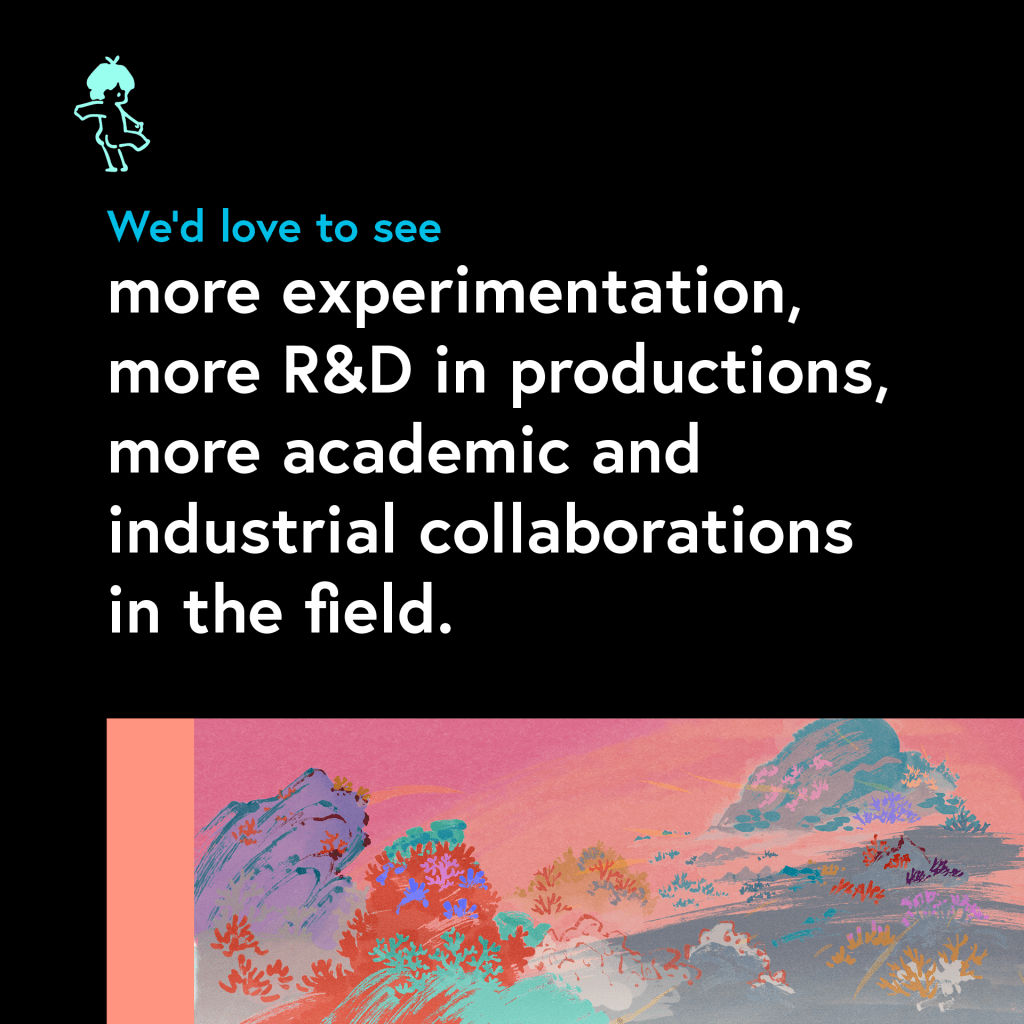
In the fast-paced and expensive animation industry, efficiency and commercial success often take priority, leaving insufficient space for experimentation. We aspire to see more room for R&D in production, along with greater collaboration between academic and industrial fields.
Experimentation springs from curiosity, a quality we never want to abandon. We applaud all experimental creatives whose attempts may not always be visible on the big screen, but nonetheless advance the art form. As Studio Biped, we remain committed to the spirit of the curious toddler.
 Angela Wong's Portfolio